

Written by Pranshul Verma
February 6, 2026
A reputed college’s MBA experience can prove remarkable in your career trajectory and lure each student of management, the Common Aptitude Test or the CAT Exam in India is in the right words your doorway to that, the test conducted all over the country is accepted by all IIMs and top B-schools.

CAT Exam is conducted by a different IIM each year, for the year 2026 IIM Calcutta is set to administer the test in two slots on the 24th of November, it is a norm for the exam to be conducted on the last Sunday of November. Here is a table consisting of important dates and exam fees (tentative).
Short Overview of CAT Exam
| Exam Name | Common Admission Test (CAT) |
| Official Website | https://iimcat.ac.in/ |
| Conducted by | Indian Institute of Management ( IIM ) |
| Duration for Taking Exam | 2 hours |
| Exam Medium | English |
| Exam Mode | Computer Based Test (CBT) |
| Registration timeline | 4th August – 15th September, 2026 |
| Exam Date | November 30, 2026 (Sunday) |
| Result Date | 4th January 2026 (Expected) |
| Fees | INR 2500 |
Eligibility of CAT Exam
- A Bachelor’s degree or its equivalent is mandatory for enrollment in the CAT entrance exam. Students in their final year are also eligible for provisional admission, provided they have fulfilled all requirements to receive the degree.
- Candidates applying for the CAT Exam should fulfil any one of the following conditions or Eligibility of CAT entrance Exam.
- A minimum of 50% marks for general candidates and 45% marks for PwD (persons with disabilities), SC (Scheduled Caste), and ST (Scheduled Tribe) applicants in their undergraduate or equivalent degree is required.
- Completed professional degree (CA/CS/ICWA/Fellow of the Institute of Actuaries of India (FIAI)) with 50 per cent.
- Enrolled in a recognised institution’s final year of a Bachelor’s course, candidates must meet the minimum percentage requirement of 50% for General, EWS, and NC-OBC categories, and 45% for SCs, STs, and PwD candidates.
The percentage of marks obtained will be calculated according to the practices of the respective institutions. The process of converting CGPA to percentage will rely on the methodology employed by the institutions. Without a conversion scheme, candidates’ GPA will be divided by the maximum GPA and then multiplied by 100 to obtain the corresponding score.
Difficulty Level of CAT Exam
The IIM CAT exam undoubtedly is challenging but reducing the assessment of the difficulty of the CAT exam to a simple “yes” or “no” is inadequate. The syllabus itself is approachable and familiar to many students. However, the challenge lies in mastering important tacts and tricks that are essential in enhancing one’s response rate in a highly competitive setting. Here the way you take the paper and approach the syllabus takes precedence over the quantity you study; understanding the exam’s pattern to optimally attempt the paper, rather than solely relying on knowing every aspect of the syllabus, gives one the marginal benefit in such a rigorous competition. To refine your strategy and track your progress, consider using a Daily Study Planner to organize your preparation and regular practice sessions in a Practice Lab.
Purpose Of CAT Exam
Conducted by India’s top B-schools, the CAT Entrance Exam holds high credibility; hence, its score is widely accepted by most of India’s top institutions offering management courses. While every school might have a varying selection process, what remains a convention is their demand for a competent CAT score. Cat exam Serves an Important purpose and the importance of a fair cat score for an MBA aspirant cannot be refuted. Reputed institutions like IITs, MDI, FMS, and IBS offer thoroughly curated, prestigious management courses and high placements, all requiring a good CAT score. The number of colleges accepting the CAT score is 1000+. To understand your potential standing, you can use a CAT Percentile Predictor after taking mock tests.
CAT Exam Pattern
| TYPE OF QUESTION | MCQs and TITAs |
| NUMBER OF SECTIONS | 3 (DILR, VARC, QA) |
| NUMBER OF QUESTIONS | 66 |
| TIME FOR EACH SECTION | 40 MINUTES |
| TOTAL TIME | 120 MINUTES |
| MARKING SCHEME | +3 for the correct answer -1 for wrong MCQ answer (not TITA) 0 for unattempted |
| TOTAL MARKS | 198 |
Although the CAT exam does not adhere to a fixed pattern or a well-defined syllabus, analysing question paper patterns from the past few years can provide insights into what to expect of test patterns and weightage for the upcoming year. Utilizing a Test Series can help you familiarize yourself with these patterns and improve your time management.
*Sectional time for PwD examinees is 53 minutes and 20 seconds for each section i.e. 180 minutes for the test.
An estimated distribution of weightage of each section is illustrated below-
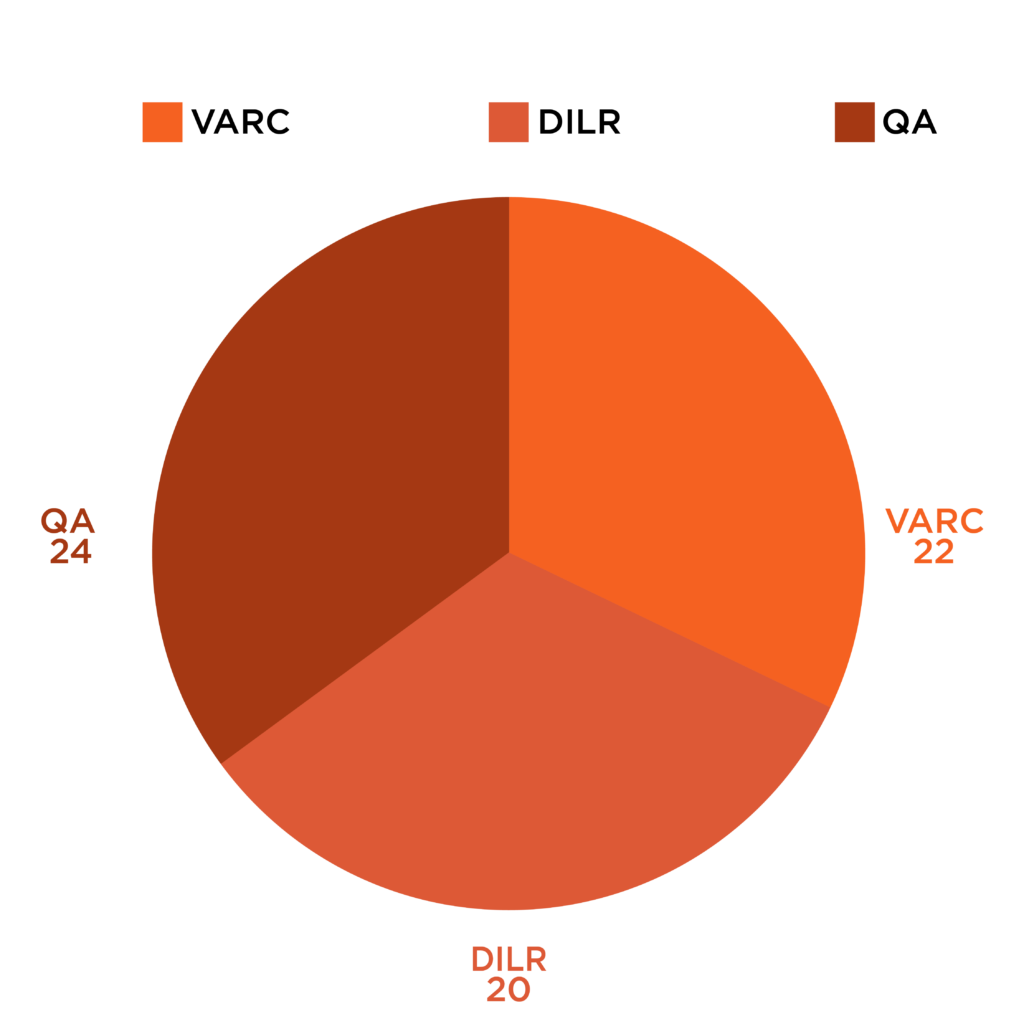
In the last few CATs candidates have noted that the VARC section followed by DILR then QA is how the exam is set. Switching between sections is not possible. There are no breaks between sections.
Out of the 66 questions, 17 are estimated to be TITA(type in the answer) which would be an estimation of – 3 from VARC, 6 from DILR and 8 from QA.
Must Read:
Is CAT EXAM Compulsory for MBA? | Other Options for MBA
Things to Carry for the CAT Exam | Complete Checklist
How to Crack CAT in 60 days? Percentilers
Syllabus of CAT Exam
Broadly, the CAT syllabus covers Math and English learning in classes VI to X of schooling. Although the framework has been broadly constant throughout the past 15 years, some specific things emerge differently every year resulting from the syllabus being largely vague and very wide. The IIMs, which administer the CAT exam, do not release an official syllabus for the test. Instead, it is inferred from the analysis of previous years’ CAT exams. By observing patterns, conclusions have been drawn regarding the exam’s structure and syllabus. To get started, consider taking a Free CAT Readiness Assessment to gauge your current preparation level.
Quantitative Aptitude
| Arithmetic | Reasoning Based DI, Matrix and Grid, Matrix Arrangement, Venn Diagram, Scheduling and Matrix, Unconventional and Hybrid Games and Tournament, Mathematical AR, Order and ranking, Missing Data, Arithmetic Caselet, Logic Based on Table, Routes and Networks, Gantt Chart. Maxima- Tools That Help With This
Q: How many questions should I aim to attempt to get a good CAT percentile?A: To achieve a high CAT percentile (e.g., 99+), aiming for 45-50 correct attempts out of 66 questions is generally a good target, assuming high accuracy. This typically translates to around 135-150 marks. However, the exact number varies each year based on the exam's difficulty. Focus on accuracy over quantity. Q: What is the ideal duration for CAT preparation?A: Most successful candidates prepare for 6 to 9 months. This allows ample time to cover the syllabus, practice various question types, take mock tests, and analyze performance. Shorter durations like 3-4 months are possible with dedicated effort, especially for those with strong fundamentals. Keep preparing with Percentilers |